
Five hiring metrics that quietly tell you something is broken

Most recruiting teams track time-to-hire and call it a day. It is a fine headline number, but it hides as much as it reveals. A slow time-to-hire could be a sourcing problem, a screening bottleneck, a scheduling mess, or a slow approval chain, and the single number tells you nothing about which. The useful metrics are the ones that point at a specific leak.
Here are five that are worth watching, because each one localizes a problem you can actually fix.
1. Time to first response
How long after a candidate applies do they hear something useful? Not an auto-acknowledgement, a real reply that moves things forward. This is the single best predictor of whether your strongest candidates stay engaged. If it is measured in days, you are losing people before your process even begins.
2. Application completion rate
Of everyone who starts an application, how many finish? A low completion rate is a flashing sign that your apply flow is too long or too cold. This number is invisible to most teams because their ATS only counts completed applications, the people who gave up never show up in the data at all.
3. Screen-to-interview time
Once a candidate is qualified, how long until they are actually on someone's calendar? This is where scheduling back-and-forth hides. A qualified candidate who waits a week for an interview slot is a qualified candidate you are likely to lose, and the delay is almost always coordination, not judgment.
4. Interview no-show rate
How many booked interviews simply do not happen? A high no-show rate usually is not about flaky candidates. It is about long gaps between booking and interview, missing reminders, or a process that never re-confirmed. It is one of the most fixable numbers on this list and one of the most ignored.
5. Source-level conversion, not source-level volume
Most teams know which sources send the most applicants. Far fewer know which sources send applicants who actually get hired. Volume flatters a channel; conversion tells the truth. Spending on a high-volume, low-conversion source is paying to fill your pipeline with people who will not finish.
Watch the leaks, not just the headline
None of these metrics replace time-to-hire, they explain it. When you can see first-response time, completion, screen-to-interview lag, no-shows, and real source conversion, the vague feeling that hiring is slow turns into a specific, fixable list. And most of what you will find is coordination, which is exactly the kind of problem automation is built to solve.
Keep reading
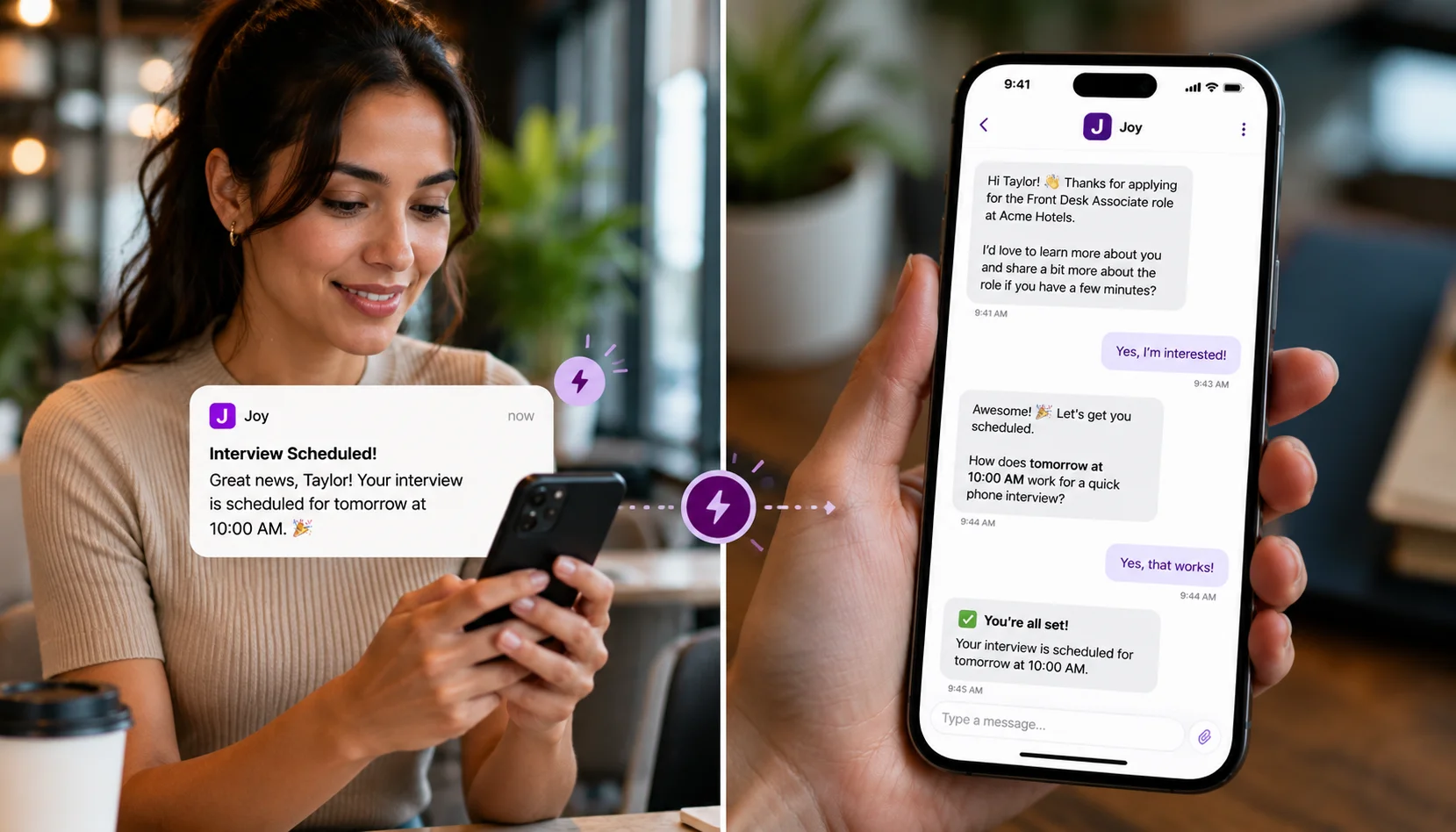
The first reply wins: why response speed decides your best hires
Strong candidates apply to several jobs at once and commit to whoever answers first. Here is why the first reply matters more than the perfect job ad, and how to make it instant.
How to double your hiring throughput without adding recruiters
High-volume hiring usually means hiring more recruiters too. It does not have to. Here is how to grow throughput by removing the repetitive work that eats your team's day.

What conversational AI actually does in hiring (and what it doesn't)
Conversational AI in recruiting is easy to misunderstand. It is not a chatbot that replaces recruiters. Here is a grounded look at the work it does and the decisions it leaves to people.